Verified > 99% Lab-grade Peptides
HPLC can sustain insurance claims concerning chromatographic purity, contamination top problem, and degradation patterns when the approach is suitable and the chromatogram is readily available. If a peptide is re-tested after storage stress, HPLC can disclose whether new contamination heights have appeared or whether the main top location has actually declined. This connects directly with taking care of subjects such as peptide storage space and peptide reconstitution. As an examples of product-level context, compare the anticipated masses for Retatrutide, BPC-157, and Semaglutide.- Residual-solvent or water-content tests can matter in production or stability contexts.Subtle differences in resources pureness and structure can cause inconsistencies in the task of the final product.A modern HPLC system contains several integrated parts, each offering a specific feature in the splitting up and detection process.This is the gold standard for peptide identification-- it verifies both the make-up and the sequence.In the common peptide COA context, top purity normally describes the percentage of complete chromatogram location stood for by the primary peptide height.

Kinds Of Pollutants Hplc Discovers
A single generic chromatographic method is frequently inadequate for peptides that are hydrophobic, highly basic, very closely associated in turn, or partially cleansed. We give HPLC and UPLC pureness analysis workflows that focus on helpful splitting up rather than just creating a percent. We design analytical operations around the sample type, series features, modification profile, and decision context. Projects may involve crude intermediates, detoxified peptides, stored great deals, client-supplied products, or materials created via our custom-made peptide synthesis platform.
Other techniques like electrophoresis, capillary electrophoresis (CE), and nuclear magnetic resonance (NMR) can also be made use of to examine peptide structure, fee, and purity, guaranteeing detailed characterization. In COA testimonial, it generally includes HPLC pureness testing, mass spectrometry identification verification, and batch-specific paperwork revealing the examined great deal, approach, results, and date. For peptide purity testing, reverse-phase HPLC is the typical theoretical design. The chromatographic purity is after that determined by contrasting the location under the main top with the overall location under all incorporated peaks.Pinnacle Laboratory is a customized provider of high-purity chemical reagents and peptides. All items noted are purely for in-vitro laboratory research and development make use of just. Discover flagship research peptides with batch-specific COA paperwork and HPLC/MS verification. Products are for in-vitro research laboratory research study use just and are not for human usage.
What Peptide Screening Can And Can Not Confirm
Examinations can be conducted making use of high-precision stablizing chambers, mimicing various settings, and applying worldwide requirements to research temporary and long-lasting stability, crucial for constant peptide performance. Some peptides stop working not since the series is wrong, however since their physical behavior in genuine solvents is improperly recognized. We offer physical property testing that helps teams function better with difficult examples. Mass spectrometry validates whether the measured mass matches the expected peptide mass. The chromatogram is the most crucial aesthetic information element on an HPLC peptide test report. It is a chart with time on the straight axis and detector response, generally UV absorbance, on the vertical axis.
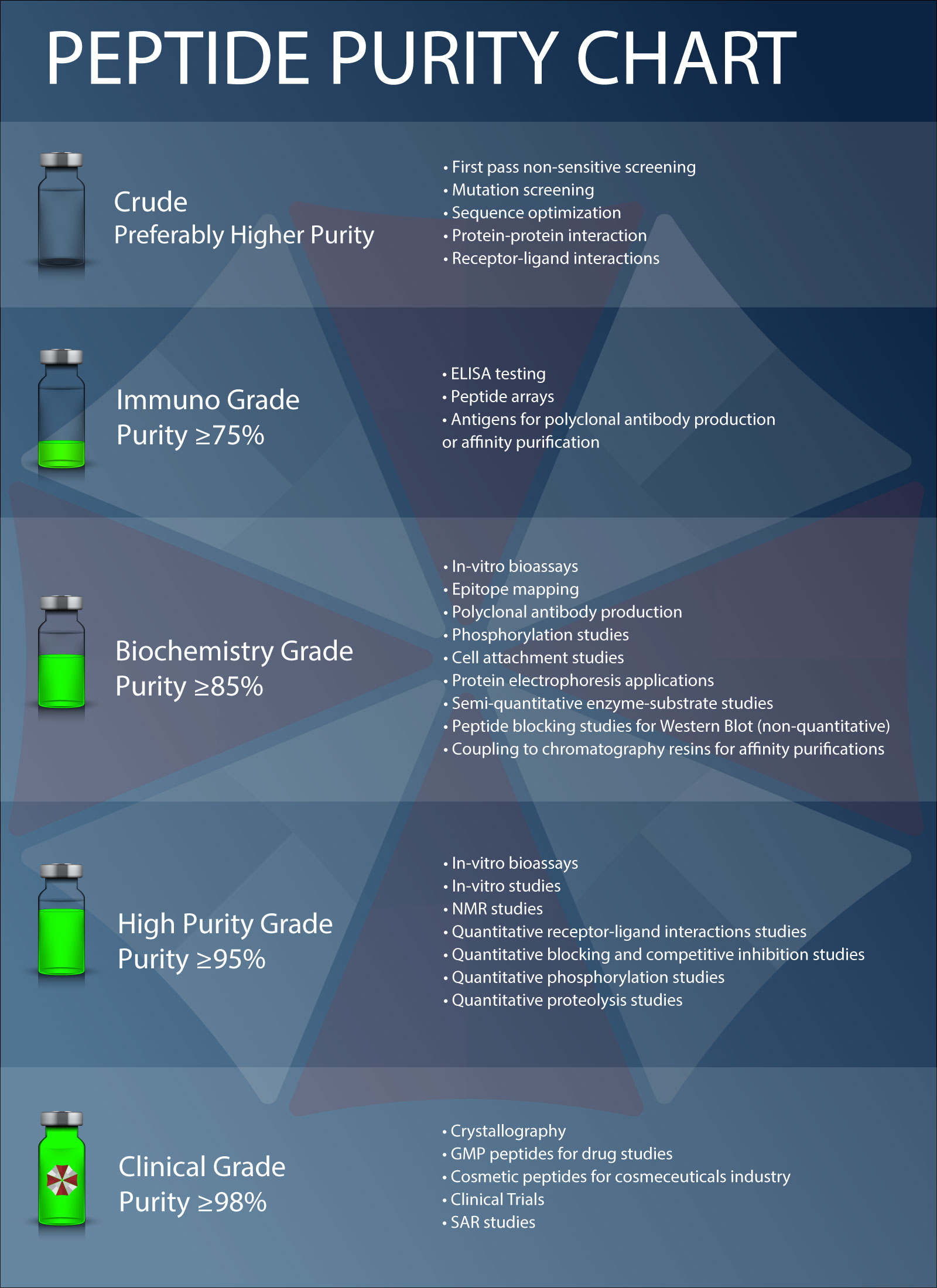
The gold criterion for gauging peptide pureness is high-performance fluid chromatography, generally abbreviated as HPLC. If you see a pureness percent on a peptide item, it almost certainly originated from an HPLC evaluation. This issues because peptides are built one amino acid each time with solid-phase peptide synthesis (SPPS). At each step, there's a little chance that something goes wrong-- an amino acid doesn't attach, the wrong modification occurs, or a side reaction generates an unintended by-product. Over a chain of 10, 20, or 40 amino acids, those little per-step mistake prices substance.
Peptide pureness refers to the amount of the proper peptide in the peptide item. However, for total high quality evaluation or the characterization of peptides for a range of applications, additional analytical examinations are suggested. For instance, in order to ensure success in various peptide experiments, it may be essential to eliminate trifluoroacetic acid (TFA), or to evaluate the solubility of hydrophobic peptides before executing the required experiments. Throughout the detection, we utilize RP-HPLC combined with MS to determine the molecular weight of the peptide. The outright amount of the appropriate peptide in an example is the item of the peptide web content and the peptide purity. BOC Sciences has a top-tier peptide high quality screening platform, incorporating innovative analytical innovations and high-end instrumentation to supply exact and reliable peptide high quality examination services.